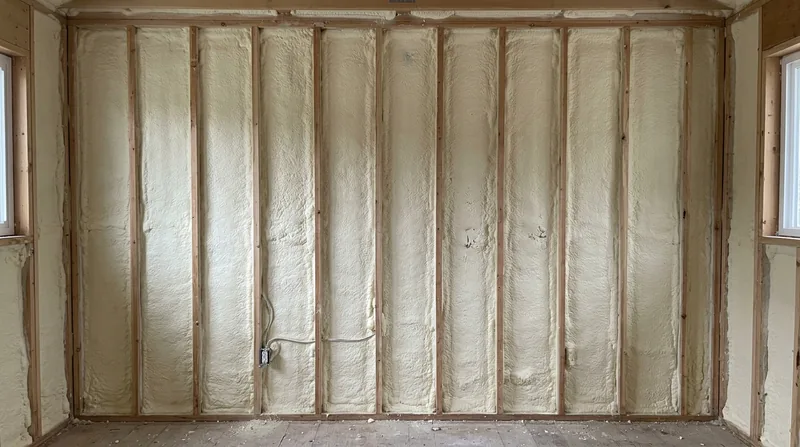




Open Cell Spray Foam Insulation in Kenosha fills the cavities in mid-century ranch walls and attics across the city, sealing air leaks and insulating in a single pass. Kenosha's housing splits sharply by age and location: early-1900s bungalows near the lakeshore sit on full basements with balloon-framed walls and tall rim joists that leak cold lake wind all winter, while post-war ranches across the rest of the city carry thin attic insulation over uninsulated rim joists. Newer subdivisions in Pleasant Prairie, Somers, and Bristol bring two-story construction with rooms built over garages, where the floor cavity becomes a chronic cold spot. In this IECC climate zone 5A, heating bills dominate and track directly with how tight the basement, rim joists, and attic plane are sealed. Open cell foam delivers both air sealing and insulation in one operation, making it a practical fit for interior walls where sound dampening also matters, and a cost-effective choice for attic top-ups on existing insulation that is still sound. Learn more about spray foam solutions for Kenosha homes.
Why Open Cell Spray Foam Matters in Kenosha's Cold Climate
Kenosha's long heating season and wind-driven infiltration from Lake Michigan make air sealing the primary defense against heat loss. Mid-century ranches with thin attic insulation and uninsulated rim joists lose conditioned air constantly through gaps at sill plates, around penetrations, and through stud cavities that fiberglass never fills completely. Open cell foam expands to fill the entire cavity, sealing air leaks that fiberglass leaves open, and it does both jobs in one pass. The material is also effective for interior walls where noise reduction matters, such as walls shared with garages or utility spaces in homes across Kenosha and Somers.
- Open cell foam expands to fill stud cavities completely, sealing air leaks that blanket insulation cannot reach.
- The material air seals and insulates in a single application, reducing labor time compared to separate sealing and insulation steps.
- Open cell foam absorbs sound, making it a practical choice for walls between living spaces and garages or utility areas.
- The product costs less per board foot than closed cell foam, making it a budget-friendly option for attic top-ups and retrofit walls.
- Open cell delivers an R-value of approximately 3.5 to 3.7 per inch, sufficient for most interior wall and attic applications in climate zone 5A.
For homeowners managing heating costs in Kenosha's cold climate, open cell foam offers a practical way to air seal and insulate without the higher cost of closed cell systems.
Key info: Kenosha's rim joist and attic air leaks account for the majority of winter heat loss in mid-century ranches. Open cell foam seals those gaps while adding insulation value, directly reducing the heating load that drives winter energy bills.
How We Install Open Cell Spray Foam Insulation in Kenosha
Open cell foam installation begins with a detailed site assessment to identify air leaks, measure cavity dimensions, and confirm the substrate is dry and sound. We prepare the work area, set up mechanical ventilation to manage off-gassing during cure, and apply the foam in controlled passes to achieve the specified thickness and density. Once the foam cures (typically 24 to 48 hours), we trim excess material and install the thermal barrier and ignition barrier required by code. The entire process is guided by the building official's requirements at your address, which vary across Kenosha and surrounding towns.
- We schedule a free site visit to assess the cavity dimensions, substrate condition, and air sealing needs specific to your home or building.
- We provide a written estimate that names the R-value, thickness, and board-foot volume required to meet your specifications and local code.
- We confirm all permits and building code requirements with the local building department before work begins.
- We set up mechanical ventilation to manage off-gassing during the spray and cure period, and we establish a clear re-entry window for your household.
- We apply the foam in controlled passes, monitoring thickness and density to meet the manufacturer's specifications and your written estimate.
- Once cured, we trim excess foam, install the thermal and ignition barriers required by code, and perform a final walkthrough with you.
This methodical approach ensures the foam bonds properly, cures to full strength, and meets both code and your performance expectations. For more detail on our process and credentials, request a free estimate today.
Example: A ranch home in Mount Pleasant with an uninsulated attic and thin fiberglass receives an open cell top-up to R-38, bringing the attic plane to code and sealing air leaks around recessed lights and penetrations that fiberglass alone cannot address. The job takes one day, mechanical ventilation runs for 24 hours, and the homeowner re-enters the attic after the cure window closes.
Open Cell vs. Closed Cell: When Each Makes Sense
Open cell and closed cell foams serve different purposes and suit different applications. Open cell foam is lighter, less dense, and lower cost per board foot, making it ideal for interior walls, attic top-ups, and sound control. Closed cell foam is denser, carries a higher R-value per inch, and provides a vapor barrier, making it the choice for rim joists, crawl spaces, and metal buildings where moisture control and structural integrity matter. The decision is not about which foam is better, but which one solves your specific problem.
| Approach | Description | Best for |
|---|---|---|
| Open Cell Foam | Lower density, expands to fill cavities, R-value 3.5-3.7 per inch, absorbs sound, no vapor barrier. | Interior walls, attic top-ups on sound substrates, sound control, budget-conscious retrofits. |
| Closed Cell Foam | Higher density, R-value 6.0-7.0 per inch, acts as vapor barrier, structural strength, moisture resistant. | Rim joists, crawl spaces, metal buildings, basements, wet or damp environments, sealed roof decks. |
| Blown-In Fiberglass | Loose-fill mineral fiber, R-value 2.2-2.7 per inch, low cost, does not air seal, settles over time. | Attic top-ups on sound insulation where air sealing is not required, budget-limited projects. |
| Injection Foam Retrofit | Low-pressure foam injected into closed walls without demolition, R-value 3.5-4.0 per inch, addresses thermal bridging. | Pre-1980 homes with empty wall cavities, retrofit insulation without interior demolition, wall and injection foam in Kenosha. |
The choice between open cell and closed cell is determined by your specific need: air sealing and insulation on a tight budget calls for open cell, while moisture control and maximum R-value in a small space calls for closed cell. Learn more about closed cell spray foam for Kenosha applications.
Open Cell Spray Foam Insulation Cost in Kenosha: What to Expect
Open cell spray foam typically starts at $0.55 per board foot in the Kenosha area, though the final price depends on several concrete factors. Cavity size and accessibility affect labor time: a straightforward attic top-up on a flat, unobstructed surface costs less than foam sprayed into rim joists with multiple angles and tight access. Substrate condition matters as well; if the existing insulation is wet, contaminated, or compromised, it must be removed first, adding cost. The volume of foam required is measured on site at the board foot, so a written estimate with R-value and thickness specifications is essential before work begins.
Most attic top-ups in Kenosha range from $800 to $2,500 depending on square footage and target R-value. Rim joist sealing in a full basement typically runs $1,200 to $2,000. Wall cavity fills for retrofit applications in pre-war homes near downtown Kenosha or in older sections of Somers are priced per cavity and per linear foot. The best way to understand cost for your specific project is to review our detailed pricing overview and request a free estimate that includes the board-foot volume and R-value target in writing.
Getting 2 or 3 estimates from different contractors is a smart practice. A low-ball price with no R-value specification, no thickness detail, and no mention of mechanical ventilation during cure is a red flag. An honest estimate names the product, the board-foot volume, the target R-value, the thickness per pass, and the thermal and ignition barriers required by code at your address.
What to Look for When Hiring a Spray Foam Contractor Near Kenosha
Choosing a spray foam contractor is about verifying competence, confirming insurance, and understanding the permits and code requirements that apply at your address. Kenosha, Somers, Pleasant Prairie, Bristol, and other towns in the area each have their own building department, contractor registration rules, and energy code provisions. A local contractor with a local address and local plates is accountable and reachable; an out-of-state rig-and-run outfit that sprays a job in an afternoon and disappears is not.
- Confirm the contractor is fully insured and can provide a certificate of insurance naming your address as an additional insured.
- Request a written estimate that includes R-value, thickness, board-foot volume, and the thermal and ignition barriers required by your local building code.
- Ask for references from recent jobs in Kenosha or nearby towns, and call at least two to ask about the installer's behavior, ventilation setup, and re-entry timeline.
- Verify that the contractor understands the permitting and code requirements specific to your building department and your address.
- Check for any HOA architectural rules that may govern exterior work, such as spray foam on metal buildings in master-planned communities.
- Confirm that the contractor will not spray over wet, contaminated, or compromised substrates, and ask what happens if moisture or existing damage is found during the job.
- Ask about mechanical ventilation during cure, the re-entry window (typically 24 to 48 hours), and any smell or off-gassing to expect after installation.
A contractor who takes time to assess your site, provides a detailed written estimate, and answers your questions about process and code is showing you the standard of work you can expect. Contact us for a free, no-obligation estimate at (262) 287-9947.
Open Cell Spray Foam Insulation in Kenosha: Pricing Guide
| Service | Price | Details |
|---|---|---|
| Open Cell Attic Top-Up | Starting at $0.55/board ft | R-value and thickness determined by existing insulation and target performance; larger attics cost less per board foot due to scale |
| Open Cell Wall Cavity Fill | Starting at $0.55/board ft | Interior walls and retrofit cavities; cost depends on cavity size, accessibility, and whether existing insulation must be removed first |
| Rim Joist and Band Joist Sealing | Starting at $1,200 | Full basement perimeter; price varies with foundation size, access difficulty, and whether existing insulation or debris must be cleared |
| Substrate Preparation and Removal | On estimate | If existing insulation is wet, contaminated, or must be cleared before foam application, removal cost is quoted separately based on volume |
| Free Written Estimate | Free | Includes R-value, thickness, board-foot volume, and code requirements for your address; response within 24 hours at (262) 287-9947 |
Indicative pricing, the exact cost depends on square footage, finish, and site access. Free personalized estimate within 24h at (262) 287-9947.


