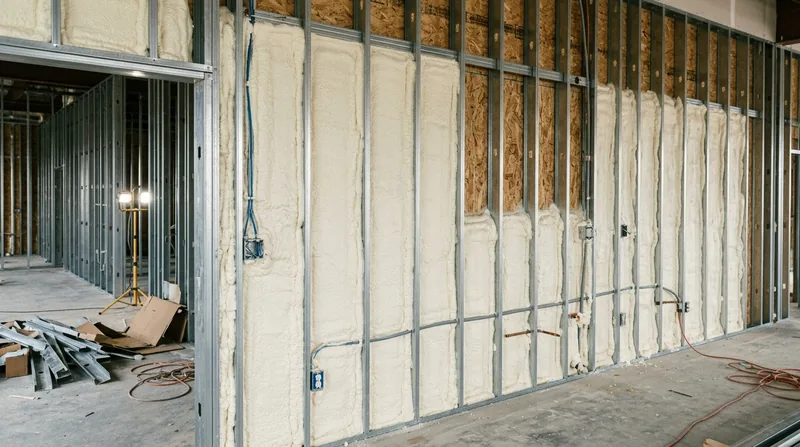




Commercial & New Construction Spray Foam in Kenosha is the insulation answer for buildings going up across Pleasant Prairie, Somers, Bristol and the newer subdivisions spreading toward Paddock Lake and Salem. When a commercial shell is framed, the energy code that applies at your address sets the R-value and thickness you need in walls and roof decks. Spray foam applied during framing seals the building envelope from day one, meets that code without compromise, and eliminates the punch-list callbacks that plague fiberglass and blown-in work on new construction. Kenosha County's long heating season and Lake Michigan's winter wind drive energy costs higher than the state average, which is why builders in this region choose foam that stops infiltration at every joint and seam. We spray walls and roof decks on new commercial projects across Greater Kenosha, size the foam to your local code, and manage the installation so the building meets energy compliance before drywall goes up.
Why Commercial & New Construction Spray Foam Matters in Kenosha and Surrounding Counties
New commercial buildings in Kenosha, Somers, and Pleasant Prairie must meet the energy code in force at their address. That code specifies minimum R-values and air-sealing requirements for walls, roof decks, and rim cavities. Spray foam applied during framing delivers both the thermal resistance and the continuous air barrier that blown-in fiberglass and batts cannot match. A building sealed with foam passes the blower door test and the thermal imaging inspection without remedial work. Builders who spray foam during framing avoid the cost and delay of post-drywall air-sealing retrofits.
- We apply closed cell or open cell foam to exterior walls during framing to meet the R-value required by your local energy code.
- We foam roof decks on new commercial construction so the attic plane is sealed and insulated before the roof deck is fastened.
- We size the foam thickness to the exact R-value your building code specifies, and we provide written estimates with R-value and thickness noted.
- We manage cure time, ventilation, and re-entry windows so the building stays on schedule and meets safety and compliance requirements.
- We remove and replace failed or inadequate insulation on retrofit jobs, and we work alongside your general contractor or construction manager to coordinate timing.
Foam applied during new construction is faster, cleaner, and cheaper than retrofitting after the building is enclosed.
Key info: Wisconsin's energy code for commercial buildings is the International Energy Conservation Code (IECC) adopted by each municipality. Kenosha, Pleasant Prairie, Somers, and Bristol each enforce their own version, and the R-value required for walls and roof decks varies by code year. We help you understand what applies at your address and size the foam to match. Verify your local building department's energy code requirements before you frame, and confirm with us in writing.
For details on energy code compliance and local permitting, contact your municipal building department or review the Wisconsin Department of Safety and Professional Services, which maintains the state's building code resources.
How We Spray Foam New Commercial Buildings in Kenosha: Step by Step
New construction projects move fast, and spray foam must fit the framing timeline without holding up the next trade. We start with a pre-job walkthrough to confirm the scope: which walls, which roof sections, and which cavities need foam. We confirm the R-value target with the builder or architect, schedule the spray for the day framing is complete or drywall is about to start, and coordinate access with the general contractor. On spray day, we set up ventilation equipment, spray the foam to the specified thickness in controlled passes, and manage the cure window so the building stays on schedule.
- We visit the site before framing or early in the frame-up to measure cavities and confirm the scope and R-value target.
- We schedule the spray date to align with the framing and drywall timeline so the building envelope is sealed before weather or interior work begins.
- We set up mechanical ventilation during the spray and cure process to manage odor and off-gassing, and we post a re-entry window notice on site.
- We spray exterior walls in sections, controlling the foam thickness per pass so the final thickness matches the R-value specified in the estimate.
- We foam roof decks from the inside, working systematically across the deck to ensure even coverage and the correct thickness before the roof membrane is installed.
- We inspect the finished foam for completeness, document the work with photos or notes, and provide a written summary of what was sprayed and the R-value delivered.
The result is a building envelope that is sealed, insulated, and ready for the next phase without callbacks or punch-list work.
Example: A new retail building in Pleasant Prairie (53158) with 8,000 square feet of exterior wall and a 2,000 square-foot roof deck over a sales floor. The energy code requires R-19 in walls and R-30 in the roof deck. We spray closed cell foam to 3.5 inches in the walls (R-21) and 5 inches in the roof deck (R-30), finish the work in two days, and the building passes the blower door test at first inspection.
For more on how foam integrates with sealed or unvented roof decks, see our closed cell spray foam page.
Commercial Spray Foam Methods: Closed Cell vs. Open Cell
| Approach | Description | Best For |
|---|---|---|
| Closed Cell Spray Foam | High-density foam with a closed cell structure. Delivers R-6 to R-7 per inch. Forms a vapor barrier and air barrier in one pass. Resists moisture and is stable in damp environments. | Roof decks, exterior walls exposed to weather, rim cavities, and any application where moisture control and air sealing are critical. Kenosha's Lake Michigan humidity and winter wind make closed cell the default for new construction near the shore. |
| Open Cell Spray Foam | Lower-density foam with open cells. Delivers R-3.5 to R-4 per inch. Requires a separate vapor barrier and is breathable, allowing drying toward the interior. Lower cost per board foot. | Interior walls where vapor permeability is desirable, sound-dampening applications, and budget-conscious projects where R-value can be achieved with greater thickness and interior barriers are in place. |
| Spray Foam Over Existing Structure | Foam applied to the exterior of an existing building frame or to the interior of a new cavity. Requires the substrate to be clean, dry, and free of contamination. | Retrofit projects, metal building walls, and situations where foam is applied after framing is complete. Kenosha metal buildings and barndominiums benefit from closed cell spray foam to prevent condensation on steel. |
| Partial Fill (Top-Up) | Foam applied to a fraction of a cavity depth, with the remainder left open or filled with another material. Used when code or budget limits full-cavity foam. | New construction projects where fiberglass or blown-in insulation fills the lower portion of a cavity and foam is sprayed above to meet the R-value target and seal the top of the frame. |
Commercial & New Construction Spray Foam Cost in Kenosha: What to Expect
The cost of spray foam on a new commercial building depends on the size of the building, the R-value required by your energy code, the type of foam (closed cell or open cell), and how easily we can access the cavities and roof deck. A small retail or office shell in Kenosha or Pleasant Prairie may cost less than a large warehouse or a building with complex roof geometry. We provide a free commercial estimate that includes the square footage, the foam type, the thickness required, and the total board feet and cost. The estimate is valid for 30 days and includes a breakdown so you understand what you are paying for.
Factors that move the cost up or down include the height of the building (taller buildings require more equipment and time), the accessibility of the roof deck, whether the foam is applied during framing or after drywall, and whether we are removing and replacing failed insulation from a prior project. A straightforward new-construction spray on a single-story retail building is typically lower cost per square foot than a multi-story office with complex roof decks and mechanical penetrations. We encourage you to get 2 to 3 estimates so you can compare not just price but the scope, the R-value, and the warranty terms.
For detailed pricing information and a full breakdown of what affects cost, visit our pricing page. Call us at (262) 287-9947 to schedule your free commercial estimate.
What to Look for When Hiring a Spray Foam Contractor Near Kenosha
Choosing the right spray foam contractor for your new commercial building is a decision that affects the building's energy performance, code compliance, and long-term durability. The spray foam industry includes local independent shops, national franchises, and rig-and-run crews that move from job to job with little accountability. A good contractor is fully insured, provides written estimates with R-value and thickness specified, manages ventilation and cure time professionally, and is reachable after the job is done if questions arise. Bad contractors estimate by eye, promise immediate re-entry, spray without ventilation, and disappear when the smell lingers or the foam fails to cure properly.
- Ask any contractor for proof of current insurance coverage and the name of their insurance carrier, so you can verify the policy independently.
- Request a written estimate that specifies the R-value, the foam thickness, the square footage, and the total board feet and cost, so there is no ambiguity when the work is done.
- Ask the contractor how they manage ventilation during the spray and cure, and what re-entry window they recommend before the building is occupied or drywall is installed.
- Check references from recent commercial projects in Kenosha, Somers, or Pleasant Prairie, and ask those customers about the quality of the work, the timeliness, and whether they would hire the contractor again.
- Confirm with your local building department that the contractor's approach meets the energy code and any other requirements specific to your address.
- Avoid any contractor who promises a price far below market, guarantees immediate re-entry, or cannot provide references or proof of insurance.
The best contractor is the one you can reach six months after the job is done, who stands behind the work, and who took the time to understand your building and your code requirements.
Ready to get started? Contact us for a free commercial estimate or call (262) 287-9947. We serve Kenosha, Pleasant Prairie, Somers, Bristol, and the surrounding counties.
Commercial & New Construction Spray Foam in Kenosha: Pricing Guide
| Service | Price | Details |
|---|---|---|
| Free Commercial Estimate | Free | Site visit, measurement, R-value confirmation, scope review, and written estimate with thickness and board feet specified |
| Closed Cell Spray Foam (New Construction) | Starting at $1.50 per board foot | Exterior walls and roof decks, R-6 to R-7 per inch, includes ventilation and cure management, pricing increases with building height and roof complexity |
| Open Cell Spray Foam (New Construction) | Starting at $0.85 per board foot | Interior walls and non-weather-exposed cavities, R-3.5 to R-4 per inch, lower cost option for budget-conscious projects, requires vapor barrier |
| Large Commercial Project or Multi-Building Scope | On Estimate | Warehouses, multi-story offices, complex roof geometry, or multiple buildings require site-specific pricing based on access, height, and timeline |
| Travel and Mobilization | Included | No separate travel fee for jobs in Kenosha, Pleasant Prairie, Somers, Bristol, and surrounding Kenosha County service areas |
Indicative pricing, the exact cost depends on square footage, finish, and site access. Free personalized estimate within 24h at (262) 287-9947.


