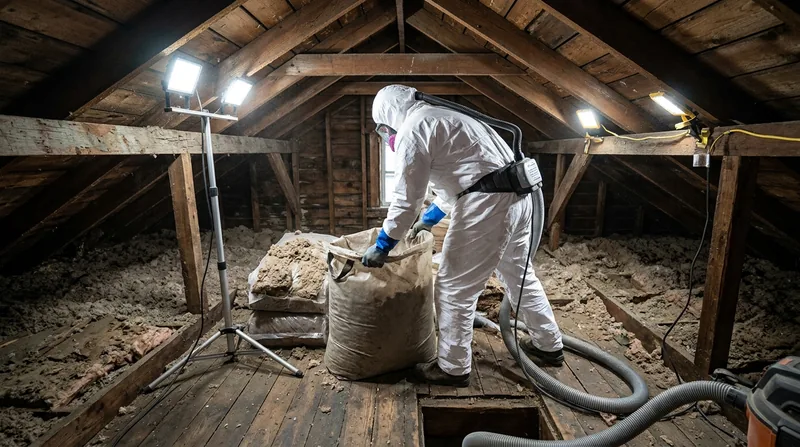




Insulation Removal in Kenosha is the foundation of any retrofit that works. Kenosha's housing stock splits sharply by age and distance from Lake Michigan. Early-1900s homes near the lakeshore and downtown carry full basements with balloon-framed walls, tall rim joists, and decades of accumulated moisture trapped in old batts, cellulose, and failed foam. Mid-century ranches across the rest of the city sit over the same full-basement foundations, with thin original attic insulation that has absorbed humidity from the lake climate for sixty years or more. Out in Pleasant Prairie, Somers, Bristol, Paddock Lake, and Twin Lakes, newer subdivisions bring two-story construction with rooms over garages, where the floor cavity is a chronic cold spot masked by insulation that no longer performs. In climate zone 5A, with a long heating season and lake humidity that drives moisture outward through walls and roofs toward the cold side, old insulation does not simply age. It fails. We remove old batts, cellulose, or failed foam, bag it for disposal, and clear the space for fresh insulation that actually fits this climate and your home's real air leakage points.
Why Insulation Removal Matters in Kenosha's Cold Climate
Kenosha's old insulation hides what decades of lake humidity do to fiberglass and cellulose. Moisture-laden air from the basement, driven upward by the stack effect and the winter heating cycle, saturates batts and blown-in cellulose. The insulation becomes a thermal sponge. Its R-value collapses. Rim joists, the thermal gateway between the basement and the living space, leak conditioned air by the room because the original insulation was never adequate in the first place. When you add new spray foam insulation over failed material, you trap moisture and create conditions for mold growth and foam failure. The only honest path is removal first.
- We remove saturated batts and cellulose by hand, bag the material, and haul it for proper disposal.
- We inspect the substrate (decking, rim joist, band joist, or crawl space framing) for moisture damage, mold, and structural integrity before any new foam is sprayed.
- We document the condition with photographs and notes so you know what you are dealing with.
- We clear fasteners, nails, and debris that would puncture or weaken new foam.
- We ventilate the space during removal to protect your home and our crew from dust and fibers.
Removal done right is the difference between a retrofit that lasts twenty years and one that fails in five.
Key info: Early-1900s homes in downtown Kenosha and along the lakeshore often carry vermiculite insulation, which may contain asbestos. We do not disturb or test vermiculite. A licensed professional must assess and handle it. Call us first if you suspect it.
How We Remove Insulation in Kenosha: Step by Step
Removal is not demolition. It is a controlled process that protects your home and sets up the next phase. We start with a walkthrough to identify the insulation type, check for moisture, and plan the scope. We then seal off the work area, bring in vacuum equipment or bagging systems to contain fibers, and remove material by hand or with light equipment. After removal, we inspect, photograph, and address any moisture or damage before we leave. The space is ready for new foam or other insulation, and you have a clear record of what was there and what we found.
- We perform a site walkthrough and photograph the existing insulation and any visible damage.
- We set up containment and ventilation to control dust and fibers during the removal process.
- We remove insulation by hand, section by section, into labeled bags for disposal.
- We clear fasteners, staples, and debris from framing and decking.
- We inspect the substrate for moisture, mold, structural damage, or pest activity.
- We document findings in writing and recommend next steps for new insulation or repair.
The entire process is tracked so you know exactly what came out and what condition the space is in.
Example: A 1950s ranch in Mount Pleasant with a 1,200 square foot attic full of damp, matted fiberglass takes four to six hours to remove by hand. A crawl space under a 1920s bungalow in downtown Kenosha with two feet of settled cellulose and standing water takes eight to ten hours, with moisture remediation handled before any new foam is sprayed. We charge by the job scope and document it in your written estimate.
Insulation Removal Methods and What Each One Handles
| Approach | Description | Best for |
|---|---|---|
| Hand removal with bagging | Crew removes insulation by hand into bags, using vacuum containment to control dust and fibers. | Attics, crawl spaces, and rim joists in homes where dust control and careful handling matter most. |
| Vacuum extraction with dumpster | Insulation is loosened and vacuumed into a collection bin, then transferred to a dumpster on site. | Large attics and commercial spaces where speed and volume matter, and outdoor air quality is not a concern. |
| Selective removal | Only failed or wet insulation is removed; sound material is left in place to reduce labor and disposal cost. | Attics with mixed insulation ages, where only the saturated sections need to come out before new foam is added. |
| Substrate cleaning and prep | After removal, decking and framing are vacuumed and wiped to remove dust, nails are pulled, and moisture is addressed. | Any space where new spray foam insulation will be applied and must bond to a clean, dry substrate. |
Insulation Removal Cost in Kenosha: What to Expect
Insulation removal in Kenosha starts at $950 for a small attic or crawl space section, and scales upward based on the square footage, insulation type, moisture damage, and ease of access. A full attic removal in a 1,500 square foot home typically runs $1,800 to $3,200. A crawl space with moisture issues, settled cellulose, and limited headroom can run $2,500 to $4,500. The biggest cost drivers are square footage, how wet the material is, and whether the substrate needs repair or mold remediation after removal. We provide a written estimate with labor, disposal, and any substrate prep included, so you know the total before work starts. Get two or three estimates from local contractors so you can compare scope, method, and price. The cheapest estimate is often the one that cuts corners on ventilation, containment, or substrate inspection, and you pay for that later when new insulation fails or mold returns.
For a detailed pricing breakdown and to understand what moves the cost up or down for your specific situation, see our full pricing overview. Call us at (262) 287-9947 for a free, no-obligation estimate within 24 hours.
Insulation Removal Near Me: What to Look for When Hiring a Contractor in Kenosha
Insulation removal sounds simple until you realize what can go wrong. A crew that rushes the job, skips dust containment, and leaves the substrate wet or contaminated has just created the foundation for your next insulation failure. The contractor you hire must be fully insured, provide a written estimate that names the square footage, insulation type, and disposal method, and offer references from recent jobs in Kenosha or nearby towns like Somers, Bristol, or Mount Pleasant. Ask to see their insurance certificate and verify coverage includes liability and workers compensation. Do not hire based on price alone. Ask what happens if they find mold, vermiculite, or moisture damage during removal. A good contractor walks away from a wet crawl space or a moldy attic and refers you to a licensed professional. A bad one sprays foam over it and vanishes when the smell returns.
- Verify the contractor is fully insured and provide an insurance certificate before work begins.
- Request a written estimate that specifies the square footage, insulation type, disposal method, and labor cost.
- Ask for references from at least two recent removal jobs in Kenosha or the surrounding area.
- Confirm the contractor has a plan for dust containment and ventilation during removal.
- Clarify what happens if moisture, mold, or damage is found during removal and who handles remediation.
- Check whether permits are required for your address and confirm the contractor understands local building code.
The right contractor makes removal the launchpad for a retrofit that lasts. For a free estimate and to discuss your specific situation, contact us today.
Local insight: Kenosha and Racine County building departments require permits for attic work in some jurisdictions and not others. Always check with your city or village before hiring. We help you navigate what applies at your address, but the final call is the building official's, not ours.
What Happens After Removal: Preparing for New Insulation
Once old insulation is out, the real work begins. We inspect the substrate for moisture, mold, structural damage, and pest activity. If the rim joist or decking is wet, we stop. Moisture must be addressed first, or new foam will fail. If the attic has active roof leaks, those are fixed before we spray. If a crawl space has standing water, it is pumped out and the source is controlled. We do not spray over wet, contaminated, or leaking substrates. That is the line, and it is the difference between a retrofit that works and one that does not. Once the space is dry and clean, we are ready to install new spray foam insulation or open cell foam, depending on your climate zone and budget. The removal is not the end. It is the foundation.
Insulation Removal in Kenosha: Pricing Guide
| Service | Price | Details |
|---|---|---|
| Small attic or crawl space section | Starting at $950 | Hand removal with bagging, up to 300 square feet, includes substrate inspection and cleanup |
| Full attic removal | Starting at $1,800 | Typical 1,500 square foot attic with fiberglass or cellulose, includes disposal and substrate prep for new foam |
| Crawl space with moisture or settled cellulose | Starting at $2,500 | Limited headroom, wet material, and substrate inspection add labor and specialized equipment to the removal scope |
| Rim joist or band joist removal | Starting at $1,200 | Focused removal of failed foam or old batts from basement perimeter, typically 200 to 400 linear feet |
| Travel and estimate | Included | No separate mileage fee or call charge for Kenosha and surrounding service areas; free written estimate within 24 hours |
Indicative pricing, the exact cost depends on square footage, finish, and site access. Free personalized estimate within 24h at (262) 287-9947.


