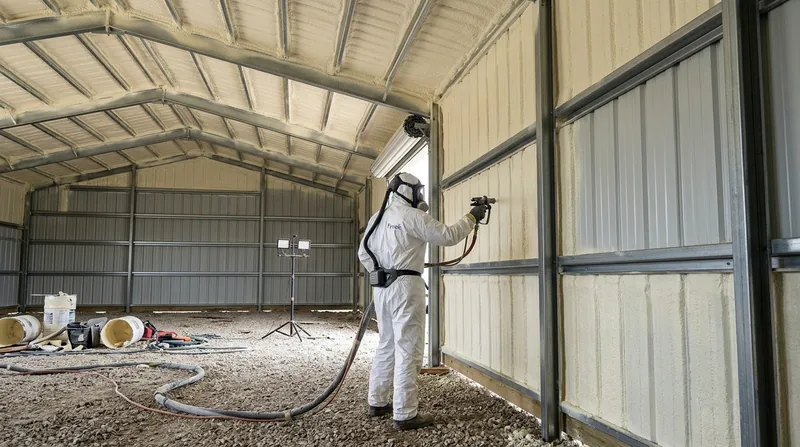




Metal Building & Barndominium Spray Foam in Kenosha stops the wind-driven heat loss that dominates every uninsulated metal structure across Kenosha County. Metal buildings and detached shops take the same relentless lake wind and winter cold as the houses nearby, but without the thermal mass and air sealing of a residential foundation. A metal roof deck and steel walls shed heat in minutes without insulation, and condensation on the cold steel can rot the structure from inside. We spray closed cell foam directly on the roof deck and walls from inside so the structure holds heat through Kenosha's long heating season and the condensation never forms.
Metal buildings in Pleasant Prairie, Somers, and Bristol sit exposed to the same pressure that drives cold air through rim joists and attics across the county. Barndominiums and converted farm shops face an extra challenge: they must handle both the envelope tightness of a house and the metal condensation problem of a shed. Spray foam solves both at once, and it does so without the weight penalty of traditional batt insulation or the vapor barrier complexity that trips up retrofit work on steel.
Why Metal Building Insulation Matters in Kenosha's Cold Climate
Kenosha's position on Lake Michigan and its long heating season create the exact conditions where uninsulated metal fails fastest. Wind-driven infiltration and thermal loss through a bare metal roof or wall can cost hundreds of dollars per month in heating fuel. Steel conducts heat at roughly 50 times the rate of wood, so a metal building without insulation is thermally transparent. Condensation forms on the inside of the cold steel when warm, humid air from inside meets the metal surface, and that condensation rots framing, rusts fasteners, and can destroy stored equipment in weeks.
- Spray foam creates an air barrier and thermal break on the metal surface so condensation never forms.
- Closed cell foam (the standard for metal buildings) carries an R-value of 6.5 to 7 per inch and stops both heat loss and moisture drive.
- A 2-inch layer on a metal roof deck delivers R-13 to R-14, enough to hold the inside surface temperature above the dew point year-round.
- The foam bonds to the metal and becomes part of the structural diaphragm, adding racking resistance in high wind.
- Spray foam does not require a separate vapor barrier, framing cavity, or mechanical ventilation the way fiberglass or cellulose would on a metal building.
Metal buildings in Kenosha and Racine County that lack insulation and air sealing will develop condensation and heat loss that no other retrofit can fix as completely.
Key info: A 40 by 60 metal shop in Sturtevant or Mount Pleasant loses heat through bare walls and roof at a rate that can cost $300 to $500 per month in winter fuel if the building is heated at all. Spray foam to R-13 on the roof and R-11 on the walls stops that loss and eliminates condensation damage that would otherwise require structural repair.
For more on how spray foam handles moisture and thermal performance, see our page on closed cell spray foam insulation.
How We Insulate Metal Buildings and Barndominiums in Kenosha
Metal building spray foam is installed from inside the structure, starting with the roof deck and moving to the walls. We verify the substrate is dry and free of loose rust or scale, set up mechanical ventilation to manage isocyanate vapors during the cure, and apply the foam in passes that respect the manufacturer's thickness limits per pass (usually 1.5 to 2 inches) and the drum temperature and ratio. Once the foam is cured and cooled, we apply the required thermal barrier (typically a thin intumescent paint or a fabric facing) to meet code, and the building is ready for re-entry and use.
- We inspect the metal surface and clean away rust scale, dirt, and moisture that would prevent adhesion.
- We install mechanical ventilation in the building during spray and for the full cure window so isocyanate vapors are exhausted to the outside.
- We spray closed cell foam in controlled passes, stopping at the manufacturer's maximum thickness per pass to avoid exothermic overheating.
- We verify foam density and thickness with probes and calipers to confirm the R-value specification is met.
- We apply the thermal barrier coat after the foam has cooled to room temperature and cured hard.
- We schedule re-entry only after 24 to 48 hours of cure time and airflow, and we provide the re-entry window in writing.
The entire process is site-specific: a 30 by 40 metal shop in Bristol takes a different approach than a 60 by 100 barndominium in Pleasant Prairie, but the core discipline remains the same.
Example: A metal-framed barndominium in Somers with living space on the upper level and storage below needs the roof deck sprayed to R-13 and the exterior walls sprayed to R-11, with careful attention to the thermal barrier so it meets the building code for an occupied structure. We work with the owner to schedule the work when the building can be unoccupied for 48 hours, and we coordinate with any local permits the Somers building department may require.
For more on our insulation removal and preparation process, see insulation removal in Kenosha.
| Approach | Description | Best for |
|---|---|---|
| Closed Cell Foam, Roof Deck | 2 to 3 inches sprayed directly to the metal roof deck, R-13 to R-21, acts as thermal break and condensation barrier. | All metal buildings and barndominiums; prevents condensation and delivers the highest R-value per inch. |
| Closed Cell Foam, Walls | 1.5 to 2.5 inches on the interior face of metal walls, R-10 to R-18, stops infiltration and heat loss. | Shops, garages, and barndominiums where wall insulation is needed without adding exterior thickness. |
| Closed Cell Foam, Rim and Band Joists | 1.5 to 2 inches sprayed to any wood framing or concrete band joist where metal meets the foundation, seals air leaks. | Metal buildings set on concrete pads or wood sills; eliminates the cold junction where metal meets masonry or wood. |
| Full Encapsulation with Thermal Barrier | Roof and walls sprayed, thermal barrier applied, building code compliance certified in writing. | Barndominiums and occupied metal structures; meets energy code and provides a finished, code-compliant interior. |
Metal Building & Barndominium Spray Foam Cost in Kenosha: What to Expect
Metal building spray foam typically starts at $1.75 per square foot for the foam and thermal barrier combined, but the actual cost depends on the size of the building, the R-value target, access to the roof and walls, and whether the substrate needs prep work. A 40 by 60 metal shop with a 2,400 square foot roof and walls will cost more in total dollars than a small 20 by 30 storage building, but the per-square-foot rate may be lower because the job is larger and crew efficiency is higher. Barndominiums with mixed-use space (living area plus storage) may require a higher R-value on certain walls to meet energy code, which raises the per-square-foot cost.
The biggest cost drivers are the thickness of foam (R-value), the condition of the metal surface (rust or contamination that requires cleaning), and roof or wall access (a 40-foot peak requires different equipment than a 20-foot wall). A metal building with a leaking roof or standing water in the floor will not be sprayed until the moisture is fixed, which is an additional cost separate from the foam.
Get two or three estimates from local contractors and compare the R-value, the thickness specification in writing, and the thermal barrier detail. A low estimate with no R-value and no thickness spec is a red flag. See our full pricing overview for more detail on what drives cost.
Metal Building & Barndominium Spray Foam Near Me: What Kenosha Homeowners Should Know
Hiring the right spray foam contractor is a matter of verifying three things: that the contractor is fully insured and can provide a current certificate, that the estimate includes the R-value and thickness in writing, and that the contractor has a local address and phone number you can reach after the job is done. Spray foam work in Kenosha may require a building permit depending on the city and the scope of work. Call your local building department (Kenosha, Somers, Pleasant Prairie, Bristol, Sturtevant, or Mount Pleasant) and ask whether the work you are planning requires a permit and what contractor registration is required in that city.
- Verify the contractor is fully insured and ask for a current certificate of insurance that names your project.
- Get the estimate in writing with the R-value, thickness, and square footage clearly stated.
- Ask whether the contractor will handle permitting or whether you are responsible for pulling the permit yourself.
- Check references from recent metal building or shop projects in Kenosha County, not just roofing or general construction.
- Confirm the re-entry window (24 to 48 hours) and the ventilation plan during cure in the estimate.
- Ask what thermal barrier will be applied and whether it meets code for occupied versus unoccupied space.
Avoid contractors who promise immediate re-entry, who offer a price far below the market range, or who cannot provide insurance documentation. A local shop with a local phone number and a track record in Kenosha and Racine County is the safest choice. Contact us for a free estimate and a detailed walkthrough of what the job will cost and how we will execute it.
Metal Building & Barndominium Spray Foam in Kenosha: Pricing Guide
| Service | Price | Details |
|---|---|---|
| Metal roof deck, closed cell foam | Starting at $1.75/sq ft | 2 to 3 inches, R-13 to R-21, includes thermal barrier paint applied after cure |
| Metal walls, closed cell foam | Starting at $1.75/sq ft | 1.5 to 2.5 inches, R-10 to R-18, interior application stops infiltration and heat loss |
| Full metal building encapsulation | On estimate | Roof and walls combined with complete thermal barrier; cost depends on building size, roof height, and substrate condition |
| Substrate prep and moisture remediation | On estimate | Rust removal, cleaning, or moisture repair required before spray; scope determined on site |
| Travel and mobilization | Included | No separate charge for jobs in Kenosha, Somers, Pleasant Prairie, Bristol, Sturtevant, Mount Pleasant, or surrounding areas |
| Free estimate | No charge | Written estimate with R-value and thickness specs, response within 24 hours at (262) 287-9947 |
Indicative pricing, the exact cost depends on square footage, finish, and site access. Free personalized estimate within 24h at (262) 287-9947.


