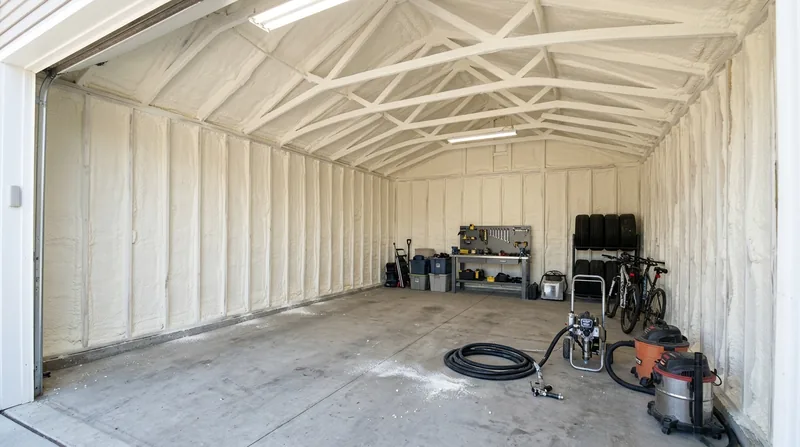




Garage spray foam insulation in Kenosha stops the heat loss that turns detached garages into cold boxes every winter. Across Kenosha County, from the lakeshore neighborhoods to the subdivisions in Somers, Pleasant Prairie, and Twin Lakes, detached garages take the same lake wind that hits the houses out front. A garage with uninsulated walls and ceiling bleeds conditioned heat through the rim joists and band joists that frame the space, and through every gap where the roof meets the walls. In climate zone 5A, with a heating season that spans October through April and lake-driven wind that pushes infiltration into every sill and penetration, an uninsulated or poorly insulated garage becomes a thermal sieve. We foam the walls and ceiling so the space holds heat for workshop and vehicle storage, cuts the strain on your heating system, and keeps the space usable on winter mornings when you need it.
Why Garage Insulation Matters in Kenosha's Cold Climate
Kenosha garages sit on the same foundation footprints as the houses they serve, but without the interior conditioning. A detached garage over a full basement or a concrete slab loses heat through three planes: the ceiling, the walls, and the rim joist band that frames the floor and wall transition. Lake Michigan wind drives infiltration at every structural seam, and a garage with no air sealing and thin or missing insulation will show outdoor temperatures inside within hours of a cold front. This is not a comfort issue alone. A cold garage means higher heating costs for the house, because any door or opening between the garage and the conditioned home pulls warm air out and cold air in. Winter vehicle storage becomes risky when interior temperatures drop below freezing, and workshop time is cut short because the space never warms enough to work safely or comfortably.
- Uninsulated or thin garage ceilings and walls allow heat to escape directly to the cold attic or outside air above.
- Rim joists and band joists around the garage perimeter are major air leakage paths that spray foam seals completely.
- Detached garages in Kenosha lose heat fastest when wind comes off Lake Michigan, pushing cold air through every gap and crack.
- A properly insulated and air-sealed garage holds heat longer, reduces heating load, and keeps vehicles and tools in a stable environment.
Getting a garage insulated and sealed is a direct investment in usable space and lower heating bills for the whole home.
Key info: In subdivisions around Somers and Pleasant Prairie where newer homes have rooms built over garages, the floor cavity between the garage and the room above is a chronic cold spot. Spray foam in the ceiling joist bay and along the rim joist stops that heat loss and keeps upstairs rooms warmer in winter.
For guidance on permits and building code requirements in your specific Kenosha neighborhood, consult your local building department or visit the service areas page to confirm what applies at your address.
How We Insulate and Air-Seal Garages in Kenosha
Garage insulation starts with a site inspection to map the structure, identify air leakage points, and determine the best foam type for your use. We measure ceiling height, wall cavity depth, and the rim joist configuration, then recommend either closed-cell foam for maximum R-value and moisture control, or open-cell foam for cost-effective coverage and sound dampening. The job involves sealing all rim joists, band joists, and the perimeter where the garage walls meet the foundation, then foaming the ceiling cavity and any exterior walls. Mechanical ventilation runs during the cure period to manage off-gassing, and we specify a re-entry window of 24 to 48 hours before the space is used normally.
- We inspect the garage structure, identify air leakage paths, and measure all cavities before recommending foam type and thickness.
- We seal rim joists, band joists, and perimeter gaps with spray foam to stop infiltration at the foundation line.
- We foam the ceiling cavity to the R-value needed for your climate zone and use case, applying foam in controlled passes to ensure proper thickness and density.
- We run mechanical ventilation during cure to manage VOC off-gassing and specify the re-entry window in writing.
- We remove any old or failed insulation before foaming, so the substrate is clean and ready for a new foam bond.
Every job ends with a walkthrough, a written estimate showing R-value and thickness specs, and clear guidance on what to expect during cure.
Local example: A detached garage in Mount Pleasant with a 20-by-24-foot footprint and an 8-foot ceiling over a full basement gets closed-cell spray foam 3.5 inches thick in the ceiling cavity (R-21 minimum) and continuous sealing along the rim joist and band joist at the foundation line. The job takes one day, and the garage holds heat for workshop use even in February.
For more on how foam is applied and what happens during cure, see our open-cell spray foam and closed-cell spray foam pages for detailed technical guidance.
Garage Insulation Methods and Foam Types
| Foam Type | Description | Best for Garages |
|---|---|---|
| Closed-Cell Spray Foam | High-density foam with closed cells, R-value around 6 to 7 per inch, acts as vapor barrier, excellent moisture control. | Garages over basements or concrete slabs where moisture risk is high, or where maximum R-value in minimal thickness is needed. |
| Open-Cell Spray Foam | Lower-density foam with open cells, R-value around 3.5 to 4 per inch, more cost-effective, good sound dampening. | Garages where budget is a priority and the space has good roof ventilation or is in a dry climate zone. |
| Foam + Blown-In Cellulose Hybrid | Spray foam seals rim and band joists, then blown-in cellulose tops up the ceiling cavity for cost savings. | Large garage ceilings where the primary goal is air sealing and secondary insulation can be less dense. |
| Rim Joist and Perimeter Foam Only | Spray foam seals the rim joist and band joist, leaving the ceiling to be insulated with fiberglass or blown-in separately. | Budget-conscious projects where the rim joist air seal is the priority and ceiling insulation is added later. |
The right method depends on your garage size, the substrate condition, moisture risk, and your timeline and budget. We help you choose the option that delivers the best return on your investment.
Garage Spray Foam Insulation Cost in Kenosha: What to Expect
Garage insulation pricing depends on the foam type, the total square footage of ceiling and walls, the complexity of the rim joist and band joist configuration, and whether old insulation must be removed first. A small detached garage with a basic ceiling foam job can start around $1,200 to $1,800, while a larger garage with walls, ceiling, and full rim joist sealing can run $2,500 to $4,500 or more. Closed-cell foam costs more per board foot than open-cell, but delivers higher R-value in less thickness and provides better moisture control. Access to the structure, the condition of the substrate, and the need for insulation removal all affect the final cost. The best approach is to get two or three written estimates that specify the foam type, R-value, thickness, and total board feet, so you can compare apples to apples.
Travel to Kenosha and surrounding areas is included in our estimate, with no separate mileage fee. Call (262) 287-9947 for a free, no-obligation estimate, and we will respond within 24 hours. See our pricing page for more detail on what drives costs and what to expect for different job sizes.
What to Look for When Hiring a Spray Foam Contractor Near Kenosha
Finding the right contractor for garage insulation means checking credentials, getting multiple estimates, and understanding what you are paying for. The insulation trade includes both local independents and national franchises, and also rig-and-run crews who spray a job in an afternoon and disappear when the smell will not go away. A reputable contractor will provide a written estimate with R-value and thickness specs, explain the foam type and why it suits your garage, run mechanical ventilation during cure, and specify a re-entry window in writing. Ask for references from recent garage jobs in Kenosha or nearby areas, and verify that the contractor carries full insurance. If your garage is in an HOA-governed subdivision, check the architectural guidelines to confirm that insulation work does not require approval. Wisconsin law requires utility locates before any excavation, but insulation work rarely involves digging, so do not let a contractor overstate that requirement.
- Request a written estimate that names the foam type, R-value per inch, total thickness, and total board feet to be sprayed.
- Ask whether the contractor will remove old insulation before foaming, and what that cost is if it is not included.
- Verify full insurance coverage and ask to see a certificate of insurance before work begins.
- Check references from recent garage jobs and ask about the contractor's response if issues arise after the job is done.
- Confirm that mechanical ventilation will run during cure and that a re-entry window of 24 to 48 hours is specified in writing.
If you have questions about permits or building code requirements for your specific address in Kenosha, contact your local building department before getting estimates. Contact us for a free estimate and we will walk you through the process and answer any questions about how we work.
Garage Spray Foam Insulation in Kenosha: Pricing Guide
| Service | Price | Details |
|---|---|---|
| Small garage ceiling (up to 400 sq ft) | Starting at $1,200 | Open-cell foam 4 inches thick in ceiling cavity, rim joist sealing, includes insulation removal if needed |
| Medium garage with ceiling and walls (400-600 sq ft) | Starting at $2,000 | Closed-cell foam ceiling and walls, full rim joist and band joist sealing, mechanical ventilation during cure |
| Large garage or complex retrofit (600+ sq ft) | On estimate | Full foam coverage with walls, ceiling, rim joists, and perimeter sealing requires on-site measurement and substrate inspection |
| Rim joist and perimeter sealing only | Starting at $800 | Closed-cell foam seals foundation line and band joist, stops air infiltration, does not include ceiling insulation |
| Travel and estimate | Included and free | No mileage fee in Kenosha and surrounding service areas, free written estimate with R-value and thickness specs |
Indicative pricing, the exact cost depends on square footage, finish, and site access. Free personalized estimate within 24h at (262) 287-9947.


