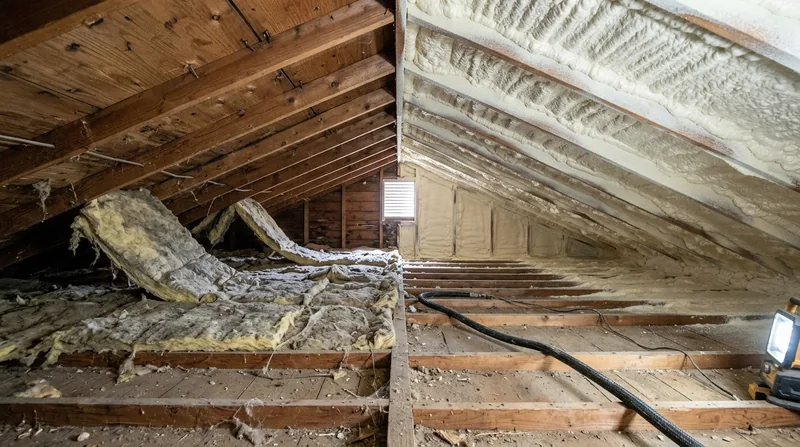




Insulation Replacement & Re-Insulation in Kenosha is one of the most direct ways to cut heating costs in homes built before energy codes tightened. Kenosha's mid-century ranches and post-war bungalows were often insulated with thin batts or loose fill that has settled, compacted, or degraded over fifty years or more. Lake Michigan's winter wind and the region's long heating season push conditioned air out through every gap in attics, rim joists, and basement band boards. When old insulation fails, you lose control of temperature and humidity, your heating system works harder, and moisture that should stay dry begins to move inward where it can cause rot and mold. We remove failed insulation, seal air leaks at the top plate and around penetrations, and install spray foam to meet current energy code requirements for your address. The result is a tight, properly insulated envelope that holds heat where it belongs.
Why Insulation Replacement Matters in Cold, Windy Kenosha
Kenosha sits in IECC climate zone 5A, a cold and humid region with heating bills that track directly to how tight your attic and rim joists are sealed. Homes built in the 1950s through 1970s typically have 3 to 6 inches of batts or blown-in fiberglass in the attic, which falls short of today's code minimums of R-38 to R-49 depending on your zip code. Worse, that old insulation rarely has air sealing around it. Wind-driven infiltration at the attic plane, through rim joists over unheated basements, and around rim-mounted ductwork can account for 20 to 30 percent of heating loss in homes that have never been retrofitted. Kenosha's lake-effect cold and the region's humidity make moisture control critical. When you replace thin, settling fiberglass with closed-cell or open-cell spray foam and seal the air gaps at the same time, you stop that loss at the source.
- Old fiberglass batts settle and compress, losing R-value by 15 to 25 percent over decades.
- Attic air leaks around wiring, plumbing, and the top plate of rim joists pull heated air out in winter and hot air in through the basement in summer.
- Spray foam seals and insulates in one step, eliminating the gaps that fiberglass and blown-in cannot reach.
- Proper re-insulation to code levels in Kenosha typically reduces attic heat loss by 40 to 60 percent compared to original 1960s construction.
Replacing failed insulation is not optional if you want a home that stays warm and dry.
Key info: Kenosha building code requires attic insulation to meet R-38 minimum in most zones, and R-49 in some newer developments. Attic ventilation rules, ignition barriers, and thermal barriers are set by your local building department and the energy code in force at your address. We help you understand what applies to your home, but always defer to the city or town where you live for the final word on what is required. Contact your local building department or visit their website to confirm the code that governs your address.
How Insulation Replacement Works: Our Process in Kenosha
Replacement insulation starts with removal of the old material. We use commercial-grade equipment to extract settled fiberglass, blown-in cellulose, or failed foam from the attic or rim cavity without leaving dust or debris in the living space below. Once the substrate is clean and dry, we inspect for air leaks, moisture, or damage. If we find wet wood, active leaks, or mold, we address the moisture source first or we walk away. That discipline protects your investment. After the space is sealed and verified dry, we spray foam to the thickness and R-value your code requires, working in controlled passes with proper temperature and ratio, and ensuring mechanical ventilation during cure. Most attic jobs take one to two days depending on size and access. We provide a written estimate with R-value, thickness, and square footage so you know exactly what you are paying for. See our insulation removal page for details on how we handle old material safely and responsibly.
- We inspect the attic for moisture, leaks, or contamination before we remove any old insulation.
- Old material is vacuumed out with a truck-mounted system and disposed of properly off-site.
- We air seal the top plate, rim joists, and all penetrations with caulk or foam before spraying the main insulation.
- Spray foam is applied in controlled thickness passes with proper equipment calibration and mechanical ventilation during cure.
- We provide a written estimate with R-value, thickness in inches, and total square footage before we start.
The result is a sealed, insulated envelope built to code and ready to hold heat efficiently for the next 30 years.
Example: A 1,200-square-foot ranch in Kenosha with 4 inches of settled fiberglass and no air sealing typically loses 15 to 20 percent of its heating energy through the attic. We remove the old batts, seal the rim joists and top plate with closed-cell foam, and spray 5 inches of open-cell foam over the attic plane to reach R-38. Cost runs from $2,800 to $3,600 depending on access and the extent of air sealing required. Heating bills drop noticeably the first winter.
Insulation Replacement Methods: Foam Types and When to Use Them
| Approach | Description | Best for |
|---|---|---|
| Open-Cell Spray Foam | Low-density foam (0.5 lbs/cu ft) that is soft, slightly flexible, and breathes. Reaches R-3.5 to R-4 per inch. Cures in 24 hours. Low-VOC once cured and meets code. | Attic replacement in Kenosha's climate where vapor permeability is acceptable and cost is a factor. Sound dampening in rim joists. Unvented attics where condensation risk is low. |
| Closed-Cell Spray Foam | High-density foam (1.5 to 2 lbs/cu ft) that is rigid and air-impermeable. Reaches R-6 to R-7 per inch. Acts as vapor barrier and air barrier in one layer. Cures in 24 hours. | Rim joists over cold basements, sealed attic decks, and crawl spaces where moisture control is critical. Metal buildings and barndominiums where condensation on steel is a failure mode. |
| Blown-In Cellulose or Fiberglass Top-Up | Loose-fill material blown over existing sound insulation to add depth. No air sealing. Settles over time. Reaches R-3 to R-3.5 per inch depending on density. | Only when the existing attic insulation is sound, the attic plane is already sealed, and you are only adding 2 to 3 inches of depth. Rare in Kenosha replacement work. |
| Closed-Cell with Open-Cell Overlay | Closed-cell foam sprayed first for air and moisture control, then open-cell foam sprayed over it to reach target R-value at lower cost. Combines benefits of both. | Sealed attics, rim joists, and crawl spaces in Kenosha where moisture control and cost balance matter. Maximizes R-value per dollar while maintaining air barrier. |
The choice between open-cell and closed-cell depends on the cavity, the moisture risk, and your budget. We assess your situation and recommend the method that solves your specific problem. On a sound attic that only needs depth, sometimes blown-in is the right answer and we say so. See our pages on open-cell spray foam and closed-cell spray foam for technical details.
Insulation Replacement & Re-Insulation Cost in Kenosha: What to Expect
Insulation replacement pricing in Kenosha depends on the size of the space, the depth of foam required to meet code, and the extent of air sealing needed. A typical attic replacement in a 1,200 to 1,500 square foot ranch runs from $2,800 to $4,200. A larger two-story home with more complex rim joist and attic work can run $4,500 to $6,500. Crawl space replacement, which requires more labor and often closed-cell foam for moisture control, typically costs $3,500 to $5,500 depending on square footage and headroom. Factors that move the price up include difficult access, extensive air sealing around rim joists and band boards, removal of contaminated or hazardous old insulation, and the need for closed-cell foam instead of open-cell. We provide a written estimate with R-value, thickness, and total board feet before you commit. See our pricing page for more detail on what drives cost in your specific situation.
The best way to understand what your home will cost is to get 2 to 3 estimates from contractors who will show up, measure carefully, and write down the R-value and thickness they recommend. A price that seems too low or an estimate with no R-value and no thickness is a red flag. We are happy to provide a free estimate within 24 hours. Call us at (262) 287-9947 or request an estimate online.
Insulation Replacement & Re-Insulation Near Me: What Kenosha Homeowners Should Know When Hiring a Contractor
Spray foam insulation is a technical trade, and the difference between a good installation and a bad one shows up in the smell, the performance, and the durability of the work. When you are evaluating contractors for insulation replacement in Kenosha, Somers, Pleasant Prairie, or anywhere in the area, look for these markers of competence and integrity. First, ask for a written estimate that includes R-value per inch, total thickness in inches, and the square footage being covered. Any contractor who gives you a price without those numbers is guessing, and you will pay for it. Second, verify that the contractor carries liability insurance and can provide a certificate of insurance on request. Third, ask about their process during cure: proper spray foam work requires mechanical ventilation for 24 to 48 hours after application, and the contractor should tell you plainly when the space is safe to re-enter. Fourth, understand your local permit requirements. Kenosha, Somers, Pleasant Prairie, and other cities in the area have different rules about attic ventilation, ignition barriers, and thermal barriers. We help you navigate what applies at your address, but the final authority is always your local building department. If you live in a master-planned community or an HOA, check whether architectural approval is required for exterior work on metal buildings or crawl space access. Finally, check references from recent jobs in your area and ask specific questions: did the work stay on schedule, was cleanup thorough, and has the homeowner noticed a difference in heating bills. A contractor who is transparent about process, insurance, and local code is the one worth hiring.
- Ask for a written estimate that specifies R-value, thickness in inches, and total square footage being insulated.
- Verify that the contractor carries liability insurance and can provide a current certificate on request.
- Confirm that mechanical ventilation will be used during cure and ask for the re-entry timeline in writing.
- Contact your local building department to confirm permit requirements and code minimums for your address.
- Check with your HOA or homeowners association if you live in a master-planned community, especially for crawl space or exterior work.
- Ask for references from homes in Kenosha or nearby communities and call them to ask about quality, timeline, and results.
We are fully insured and have been serving Kenosha and the surrounding area since 2015. We provide written estimates with R-value and thickness specs, use mechanical ventilation during cure, and defer to your local building department on all code and permit questions. If you would like to discuss your insulation replacement project with someone who knows Kenosha's homes and climate, contact us for a free estimate or call (262) 287-9947.
Insulation Replacement & Re-Insulation in Kenosha: Pricing Guide
| Service | Price | Details |
|---|---|---|
| Attic Replacement, Open-Cell Foam | Starting at $2,800 | Typical 1,200 sq ft ranch attic, 5 to 6 inches open-cell to R-38 code minimum, includes air sealing of top plate and penetrations |
| Attic Replacement, Closed-Cell or Hybrid | Starting at $3,400 | Same size attic with closed-cell base layer for moisture control, open-cell overlay, or full closed-cell to R-49, includes rim joist sealing |
| Rim Joist & Band Board Replacement | Starting at $1,800 | Typical 1,500 linear feet of rim board over basement, sealed and insulated with closed-cell foam for moisture and air control |
| Crawl Space Replacement | Starting at $3,500 | Moisture assessment, old insulation removal, floor cavity sealed and insulated, closed-cell preferred for ground-contact moisture control |
| Multi-Area Retrofit (Attic + Rim Joists + Crawl Space) | On estimate | Whole-home insulation upgrade requires site assessment of square footage, access, moisture, and code requirements for your specific address |
| Estimate & Consultation | Free | Written estimate with R-value, thickness, and square footage provided within 24 hours, no obligation to book, call (262) 287-9947 |
Indicative pricing, the exact cost depends on square footage, finish, and site access. Free personalized estimate within 24h at (262) 287-9947.


