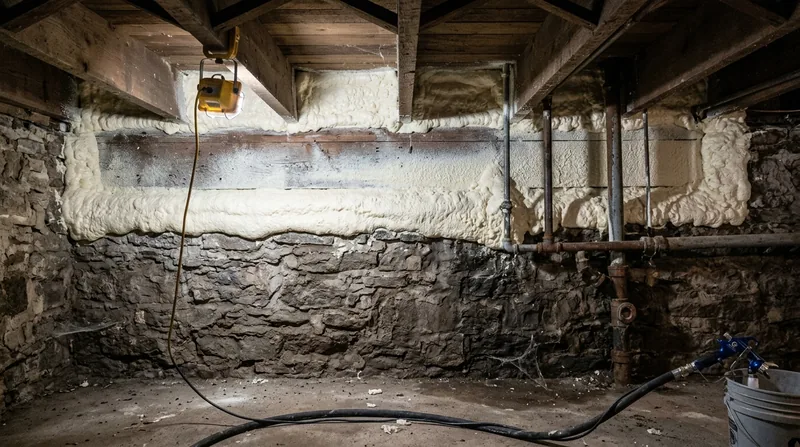




Closed cell spray foam insulation in Kenosha stops the moisture drive that pushes through walls during the long cold season, protecting rim joists, basement walls, and garage walls across Kenosha and Racine counties. Kenosha's housing stock splits between early-1900s balloon-framed homes near Lake Michigan and mid-century ranches inland, all sitting on full basements with thin attic insulation and uninsulated rim joists that bleed conditioned air all winter. The lake wind finds every gap at the sill plate and every penetration, while the long heating season pushes moisture outward through walls toward the cold side, creating the perfect conditions for infiltration and condensation. Closed cell foam resists that moisture drive with its vapor-impermeable structure, making it the right choice for rim joists, basement walls, and the floor cavities over garages that sit cold all year in subdivisions from Pleasant Prairie to Twin Lakes. We apply it in the right board feet for the job, with proper mechanical ventilation during cure and a stated re-entry window, so you get the performance without the risk. Call us at (262) 287-9947 for a free written estimate with R-value and thickness specifications, or read more about our air sealing work to understand how closed cell foam fits into the bigger picture of sealing your home.
Why Closed Cell Spray Foam Matters in Kenosha's Cold Climate
Kenosha sits in IECC climate zone 5A, where cold and humid winters drive moisture outward through walls and roofs toward the cold side. The heating season is long, and infiltration at rim joists, band joists, and basement walls accounts for a large share of the conditioned air that leaves your home without doing any work. Closed cell foam stops that outward moisture drive with its vapor-impermeable structure, making it the right answer for basement walls, rim joists, and the floor cavities over garages where condensation collects and cold persists all year.
- Closed cell foam resists moisture and prevents condensation on cold surfaces like rim joists and basement walls.
- It provides structural strength and can span gaps without sagging, making it ideal for rim joists and band joists over full basements.
- It stops the outward moisture drive during Kenosha's long heating season, protecting walls and attics from the inside out.
- It seals air leaks at the same time as it insulates, cutting infiltration at sill plates and rim joist penetrations.
In Kenosha's climate, closed cell foam is the technical choice for any application where moisture control and air sealing matter equally. Open cell foam has its place, but closed cell is the right answer for basements, rim joists, and garages.
Key info: Kenosha's early-1900s homes near the lakeshore have tall rim joists and balloon-framed walls that sit exposed to lake wind all winter. Closed cell foam applied to the rim joist and the band joist cavity seals that infiltration and stops the cold from radiating into the basement below. Mid-century ranches inland carry the same full-basement foundation, and the same rim joist heat loss, so the fix is the same.
For more detail on how closed cell foam compares to open cell for attic work, see our guide to open cell spray foam insulation.
How We Install Closed Cell Spray Foam in Kenosha
Closed cell foam is applied in thin passes, building thickness in controlled layers so the material cures properly and reaches the specified R-value without overspraying or creating voids. The process starts with mechanical ventilation to move off-gassing vapors out of the space, continues with spraying at the correct drum temperature and material ratio, and ends with a stated re-entry window of 24 to 48 hours before the space is occupied. We inspect the job on completion to confirm thickness, coverage, and that the substrate was dry and sound before we sprayed.
- We assess the substrate for moisture, gaps, and obstructions, and walk away if conditions are not right.
- We set up mechanical ventilation before spraying to move off-gassing vapors out of the space.
- We apply closed cell foam in controlled passes, building thickness to the specified R-value and board feet.
- We confirm the material ratio and drum temperature are correct before every application.
- We provide a written re-entry window and explain the curing process so you know when the space is safe to occupy.
The result is a sealed, insulated surface with no gaps, no settling, and no air leakage at the foam-to-substrate boundary.
Example: A rim joist in Mount Pleasant or Sturtevant runs 12 inches deep and 40 feet long. We spray 2 inches of closed cell foam into that cavity, achieving R-13 to R-14 and sealing the air leaks at the sill plate, the band joist, and the rim joist header all in one pass. The job takes a few hours, mechanical ventilation runs for the cure, and the basement stays sealed and insulated for decades.
For more on how we handle larger insulation jobs, see our crawl space spray foam insulation page.
Closed Cell Spray Foam Applications and Methods
| Application | Method | Why Closed Cell Works |
|---|---|---|
| Rim Joist and Band Joist | 2 to 3 inches sprayed into the cavity from rim to band, sealing the air gap at the sill plate and the foundation. | Stops infiltration at the sill plate and resists moisture from the basement, protecting the rim joist from rot. |
| Basement Walls | 1.5 to 2 inches applied to the interior face of the basement wall, from rim to slab. | Vapor-impermeable structure stops moisture from migrating inward during the heating season, preventing condensation and mold. |
| Garage Walls and Ceilings | 2 to 3 inches applied to the interior face of the wall cavity or the ceiling cavity over the garage. | Seals the thermal boundary between the heated house and the unheated garage, stopping cold air from entering the living space above. |
| Sealed Attic or Rafter Cavity | Applied to the underside of the roof deck or to the interior face of the rafter, creating a continuous air barrier. | Stops moisture and air leakage at the roof plane, protecting the attic from the long heating season moisture drive and from infiltration. |
| Metal Building or Pole Barn | Applied to the interior face of the metal frame or to the underside of the metal roof, preventing condensation on the steel. | Vapor-impermeable structure prevents condensation on cold metal surfaces, protecting the structure and contents from moisture damage. |
Closed Cell Spray Foam Insulation Cost in Kenosha: What to Expect
Closed cell spray foam typically starts at $1.20 per board foot and moves up based on the job complexity, the substrate condition, and the access required to spray. A rim joist job might run 50 to 100 board feet and cost $600 to $1,200 depending on the linear footage and the depth of the cavity. A basement wall retrofit can run 200 to 400 board feet and cost $2,400 to $4,800. A garage ceiling over a large two-car garage might run 150 to 250 board feet and cost $1,800 to $3,000. These are realistic ranges for Kenosha and the surrounding area, and the actual price depends on the site visit.
Factors that affect the cost include the linear footage of rim joist or wall to be sprayed, the depth and width of the cavity, whether the substrate is clean and dry, whether mechanical ventilation is already in place or needs to be set up, and whether the job is in a finished or unfinished space. A rim joist in an unfinished basement is a faster spray than a rim joist behind a finished wall, so access matters. A basement wall that is damp or has standing water cannot be sprayed until the moisture is addressed, so substrate condition matters. Getting 2 to 3 written estimates with R-value and thickness specifications is the smart way to compare prices and understand what each contractor is proposing.
Key info: A typical rim joist job in Kenosha or Mount Pleasant runs 40 to 60 linear feet and 12 inches deep. Two inches of closed cell foam fills that cavity completely, achieves R-13 to R-14, and costs $600 to $900 depending on access and substrate condition. A basement wall retrofit in a 30-foot by 8-foot section runs about 240 board feet and costs $2,800 to $3,200 for 2 inches of closed cell foam.
For detailed pricing on all our services and a full breakdown of what affects the cost of your specific job, visit our pricing page.
What to Look for When Hiring a Closed Cell Spray Foam Contractor Near Kenosha
Hiring the right spray foam contractor starts with verifying that the contractor is fully insured and can provide proof of coverage. Check that the contractor provides a written estimate with R-value and thickness specifications, not just a price per square foot or a vague board-foot range. Ask whether the contractor uses mechanical ventilation during the cure, what the re-entry window is, and whether the contractor inspects the finished job for coverage and thickness. Ask for references from recent jobs in Kenosha or the surrounding area, and call those references to ask about the smell, the timeline, and whether any issues came up during or after the cure.
- Verify that the contractor is fully insured and ask to see the certificate of insurance before work begins.
- Request a written estimate that specifies the R-value, the thickness in inches, and the total board feet of foam.
- Ask about mechanical ventilation during the cure and the re-entry window before the space is occupied.
- Check references from recent jobs and ask about the curing process, the smell, and any follow-up issues.
- Ask whether the contractor helps you understand local permits or building code requirements for your address.
- Get 2 to 3 estimates and compare the specifications, not just the price, so you understand what each contractor is proposing.
The right contractor is transparent about the process, honest about what closed cell foam can and cannot do, and willing to walk away if the substrate is not ready to spray. Call us at (262) 287-9947 for a free estimate with full specifications and no obligation to book.
Closed Cell Spray Foam Insulation in Kenosha: Pricing Guide
| Service | Price | Details |
|---|---|---|
| Rim Joist and Band Joist | Starting at $1.20/board ft | Includes 2 to 3 inches of closed cell foam, mechanical ventilation, and re-entry window. Linear footage and cavity depth determine total board feet. |
| Basement Wall Retrofit | Starting at $1.20/board ft | Includes 1.5 to 2 inches of closed cell foam applied to interior face. Wall height, length, and substrate condition affect total cost. |
| Garage Ceiling or Wall | Starting at $1.20/board ft | Includes 2 to 3 inches of closed cell foam sealing the thermal boundary. Garage size and access to the cavity determine total board feet. |
| Sealed Attic or Rafter Cavity | Starting at $1.20/board ft | Includes closed cell foam applied to roof deck or rafter cavity. Roof pitch, attic access, and existing insulation removal affect final cost. |
| Complex or Large-Scale Job | On estimate | Multi-zone applications, metal buildings, or jobs requiring substrate preparation require site visit for accurate board-foot count and pricing. |
| Estimate and Consultation | Free | Written estimate with R-value and thickness specifications, no obligation. Response within 24 hours at (262) 287-9947. |
Indicative pricing, the exact cost depends on square footage, finish, and site access. Free personalized estimate within 24h at (262) 287-9947.


